Tuesday, December 17, 2013

Adjusting to My New Site

So I am no longer going to do a weekly play-by-play because that would result in 96 more blogs, and I do not have that much interest in these things. Sorry, my eager fans. I can hear your sighs of disappointment all the way in South American.

I have been at site now for seven weeks. I guess I’ll start with my professional life. My first two weeks were full of meetings. My socio Miryam introduced me to a lot of people. I had about three scripts that I carried with me at all times – differing levels of formality. I met most of the authorities of the town and by virtue of my white skin and Master’s degree in psychology (I like to think that my Master’s contributes, but in reality, it’s just the white skin, I’m pretty sure), apparently, I’m some kind of authority in town too. I attended every meeting, fiesta (party), and event that I was invited to and some that I was not. The people seemed very eager to help me and were always asking what they could do. I have to write this “community diagnostic” that Peace Corps uses to help us integrate and as a time-filler. I have to collect data by means of conducting interviews, giving questionnaires, and leading small group projects that fill the gaps in the report. Super easy stuff. I don’t even have to site my sources in this thing.

By my third week, I actually got to start some kind of work. I started teaching “tutoria.” Tutoria is a government-sanctioned (that’s the Peruvian government) hour designated for each classroom that teaches the students important themes that are generally sidestepped in the regular curriculum. For example, vocational orientation, social skills, self-esteem, reproductive help. Now, one thing that I quickly learned about this country is that there are plenty of laws and regulations that are very similar to the U.S.; it’s the enforcement that is lacking. I have heard from other Volunteers and some Peruvians that tutorial is usually a free hour, kinda like our study hall. I also said that I would lead English work-shops for the kiddies twice a week. I figured that I’ve been speaking it for almost 30 years, so it should be easy to teach, right? So, I was super excited to get outta my house and start doing something and getting to know the students and teachers. Let the integration process commence! However, at the same time, I knew that maybe I was starting too soon and with too much. Back home, preparing a 45 minute lecture is a breeze, but I don’t have to translate every word of my 45 minutes lectures back home. Also, the main thing I kept hearing from Peace Corps staff and volunteers is that your first three months are incredibly boring and there’s nothing to do and the time just drags, so that made me feel like I was doing something wrong, but everybody has a different experience.

The senior girls working on a community map

Senior boys

Its not all work...

So, with the blessing of the principal, I decided to use the tutoria hour to collect data about the students. We made maps of the community, made seasonal calendars and daily schedules, and they took a 3-page questionnaire from another volunteer that I tweaked. Last week was the first week that I started actually teaching anything. I decided to start with communication skills because a.) the students expressed interest in the surveys, and b.) the listening skills are somewhat lacking here. So far so good, but the anniversary of my high school is coming up at the end of the month and that is a really big deal here, (I’m gonna write future blogs about the holiday and the school system here.) so my tutoria hours have been delayed so as to prepare for the activities of the anniversary celebration.

My English workshops started out strong, which I expected. There were more than 50 students the first two

My favorite student and cousin, Yulie
A little post-English study volleyball game
Non-formal education at its finest

workshops. I invited any student age 10 to 17, which is a big range, but I figured I would start out really slow, focusing on pronunciation, because I was expecting a strong start followed by a sharp decrease in attendance after a couple of weeks. The principal suggested that I play sports afterwards to increase the quantity of students, which seemed like a pretty good idea at the time, even though I’m not exactly an athlete and know absolutely nothing about soccer or volleyball, the ONLY two sports that ANYBODY wants to play in this entire country. Attendance did not decrease for 6 classes (3 weeks), and 50 10- to 17-year-olds is waaaaaay too many kids for me to handle alone, so I decided to split the groups – 10- to 12-year-olds on Mondays and the rest on Tuesdays. Brilliant! Easier to control the students and I only have to prepare one lesson a week instead of two! The next week, I had 7 kids show up on Monday and 9 on Tuesday. Last week there was a holiday on Monday and Tuesday, so I didn’t have the workshops, so I’m pretty nervous about whether anyone will show up or not. Teeny changes really throw people off here. I am trying to think of ways to renew interest and it has only been 5 weeks! The primary objective of both the tutorial sessions and the English workshops is further my integration into the community, especially with the youth, so I consider these things to be on a trial basis anyway. I am supposed to be creating sustainability here, so if I do not receive tangible support from another member of the community, these little “early wins” (as PC like to call them) may fall to the wayside.

Now for my life at the casa. I sleep a lot, but am always tired. I lie. I spend probably 10 hours a day in my room, but I’m only sleeping 7 or 8 hours a night usually. I mentioned before that translating all day is tiring, but the emotional roller coaster that has been my previous five months in addition to the translating and integrating keeps me in a constant state of fatigue. No, it’s not really fatigue either. It’s so hard to explain. It’s like I’m my energy level is zapped by 6pm every day. I’m ready to do nothing else but lay in the bed and watch TV way too early in the evening, but because the people are so nice here, the integration part seems so easy, like it shouldn’t be zapping my energy to just simply talk with folks in the street and eat with folks and attend the parties or play cards with the family. These are not energy-zapping activities. Of course, I am comparing this life with my life before I left the states which included two jobs, an internship, work on a Master’s and an active social life. I know I should not do this cuz they are just way too different states of being to try to compare, but it’s difficult not to. I also realize that I lived by myself at home and had plenty of time to defrag by myself in my room by myself and my Netflix. I probably spent more time in my room per week back home because usually I had at least one day where I didn’t work or only worked for 5 or 6 hours. I get a lil guilty for not spending more time with the family sometimes, but they are super understanding. My butt was glued to the toilet one day last week (I had a spell of the diarrhea), and I was actually glad for the valid excuse for alone time. Like I said in my last blog, I’m finding stuff out about myself all the time. I always thought that I was such a social creature, but dang, I really like the alone time too. WOW! Gettin all caught up in the storm that is my “mente” (mind). Sorry bout that. Moving on…Here's some more pics of my site:

A sugar farm

Average-looking house in a "chacra" (farm).
Agriculture is a huge part of the economy in my area.

Corn field

The main street through La Cria and Pampa La Victoria

My street - my house is the first one on the right

Mi casa

The Internet cafe; there are two Playstation stations (???) behind me

The back part of the house; to my left and behind me is
the shower and toilet, and to my right are the animals

Shower and little toilet room - Idk what you would call it
Right half of the back - there are puppies under that tin!
One of the "gatos" under the chicken coop


The chicken coop
Duckies!

One of the improvements I made to the hot pink room.


Me and Yessica
My family here is cool. So far, I feel a stronger connection with the family in Chaclacayo, but I spent way more time with them so far and we went through some tragic stuff. After site visit, I was most concerned about the teenagers of the house liking me. My brother works out of town, like his dad, operating heavy equipment, and apparently his blushing bride accompanies him regularly. When I arrived, Christian was off working way down south and three days after my arrival his wife left on a bus to join him, so out of the whole family, I know them the least. My teenage sister is pretty incredible. She is 19-years-old and travels to Chiclayo (46km, which equals 28 miles, but by combi, that’s over an hour one way) every weekday to go to an “instituto” (kinda like a community college) to study tourism. It’s a booming industry here. For this country where most girls her age can’t get into university so they make babies (not knocking it, just sayin), Yessica (my sister) is a super dedicated and highly motivated lady. We get along much better than I thought we would initially. She is the smartest person in the house (admitted by all). She is rather introverted. She has one best friend that is her cousin that is attached to her hip. She has other friends at school, but not a lot, and she is not really fond of parties. She has said that if and when I help start a youth group, she is my first volunteer. We don’t get to hang out as much as I would like. I leave around 8:30 in the morning at least twice a week and get back around 1:30. Yessica leaves for school on the 1pm combi and doesn’t get back til 8pm. Sometimes I’m already in bed by then. LOL! At this point, I would say that she is my best friend here.

My host mom is a domestic goddess. She is up at 7ish every day, has a hot breakfast on the table by 8:30ish
Host mom, Reyna
(my breakfast is usually to go), then cleans until 11:30ish at which point she starts preparing lunch. Lunch is always huge (no matter where you eat in this country). Then she usually hangs out in a “silla” (chair) for about an hour before she is up and at it again. Oh! And she is doing all this while running the Internet café up front. The whole family contributes, but it’s Reina’s (host mom) show. Of course, we hand wash our clothes. There has been a “lavadora” (washing machine) sitting in the box in the den since my site visit, but mom says that we don’t have the money to install the dang thing. I will pay to have it installed after I save up for a couple of months if I have to. Hand washing is so stinkin tedious and time-consuming and after about four pairs of pants (and for me, an hour later), my back starts to hurt all hunched over like that. Also, my family sweeps and mops the entire house daily and sweeps and mops the front part of the house (the Internet café and the dining and living rooms) twice daily. We live in a desert and the front and back doors are always open for the breeze and the business, so there is an inch of dust on the ground by noon. Not to mention that my littlest sister, Dayhana (pronounced “Di-yana”), the 5-year-old, is the cartoon Tasmanian Devil’s twin. Instead of the Midas touch, she’s got the Tasmanian
Me and Dayhana
touch. She leaves of trail of dirt and candy wrappers everywhere she goes. However, 80% of our time together, she has me in fits laughing hysterically and I don’t have to pick up after her, so I can’t help but love her. I spend the most time with Reina and Dayhanna. Dayhanna only attends her preschool for 3 hours a day, and Reina is usually home all day except for weekly visits to Patapo (county seat) for market days. We have a lot of laughs. The things that come outta that kid’s mouth and the facial expressions keep us in stitches.

My host dad I finally got to know just these past two weeks. He has been away at work in Cajamarca. His job was finished, so he’s back home now. He works for a company that does not guarantee steady work, but almost steady. It depends on the jobs that
Tito, "the bossman" and super cool host dad. 
they can contract and then it depends on if they decide to hire Tito (host dad) or not. For example, he was out of work for three months last year. The way that they talk though, his boss really likes him, and there is another potential job coming up next month, so everybody has their fingers crossed. Tito is a super likeable fellow. He is always smiling and cracking jokes. He was still in elementary school when he was fifteen, and the only reason he got to graduate to high school is because his mom bribed his teachers with some chickens. (I’m totally serious right now.) He didn’t graduate from high school, but he is NOT stupid. He’s not super book smart, but he’s got this intriguing wit and wisdom about him that is awesome. He rules the roost, of course, but he’s not overly machista. (Recall from previous blogs that “machista” is an advocate of “machismo,” the belief that men are superior to women.) (I said that last thing in my professor voice in case you couldn’t tell.) Plus, he’s a super great dancer. I’m going to teach him to two-step before I leave this country.

Here's a couple of pics of other extended family members:

Uncle German, Aunt Rosa, and cousin Mauricio.
German is my dad's brother, and Rosa is my mom's sister.
Seriously...It's a small town.

Captain Maury, saving the world from harm!


Uncle Wilson, Aunt Jackie, and cousin...wait for it...
David Beckham. Yup, again, seriously.
Big soccer fans, these Peruvians.
These is Yuli's family, but she was asleep when we
took this pic. 
Beckham is absolutely the craziest kid I have ever been around.
Love him!
Well, I think that that was a pretty good general overview of life “aqui” (here). Sorry for all the Spanish words, but this is the way that my brain is working. I’m really scared that I won’t be able to talk English when I get back. It’s only been 5 months. 22 more to go, people!

FIN!

Yeah, yeah, I haven’t posted a blog entry in two months. Sorry to keep you all in suspense. I’m sure no one has taken a breath this entire time. My apologies. It’s not just that I have lost some interest in writing this thing, but it takes so long to upload my pics and videos on the ancient technology here. In addition, remember that all the computers in my house are available for rent, so when I spend 2 hours at the computer, that’s S/.4 that y family just lost. All this, and I have been swept up in my “Community Diagnostic.” This is a report required by Peace Corps that is a detailed summary of everything that I have learned about my community, the conclusions I have drawn, and a brief plan for future projects. I created a ton of work for myself by handing out over 225 surveys (among four other data-gathering tools that required evaluation), so Excel has been my best friend and my most-hated enemy for the past two months. I was able to wrap everything up in 29 pages with an 8-page appendix. I turned it in last week at my first post-training training in Chaclacayo (Lima). Yep, just got back home from a fun-filled week of 8-5 classes and practicums. This is a whole blog entry in itself that I may try to get to at some point. Anyway, my Aunt June just had surgery and needs some reading material, so enjoy the next five bloggs I am about to post over the course of the afternoon.

Aaaahhhh, finally, the last week of training. At the time, as always, there were mixed emotions – dread, weariness, fear, excitement, energy, eagerness. It’s so weird. Just about the time that you are starting to get really settled in and comfortable – BOOM! You pack your things and move kilometers away.

Besides preparations for the appreciation party for the host families on Thursday and the grand finale, the swearing in ceremony, on Friday, there was little in the way of training going on at the center. We had our final language interviews (with people other than our language facilitators, which I thought was quite objective of Peace Corps) and we had to take two exams, one over the basic rules and regs of Peace Corps and another over the basics of your program, in my case youth development.

Dylan and I had a different experience than most during the final week of training. On Monday, I left my darn cell phone at the casa. Dylan and I and several others decided to hang out for a couple of hours after training to swap site visit stories. I realized it was getting late, so I called Rebeca (host-mom Rebeca) to let her know that we would be home in a little bit. I HATE talking on the phone in Spanish because there are no non-verbals to give or receive and it is harder to hear. Anyways, all I could figure out from our conversation was something about “the baby” and that she was in Lima. Dylan and I went home to find Trinidad (my host grandma) and Gustavo (my host uncle) in tears sitting in the dark in at the table with candles lit. “The baby” is Valentina. I mentioned her a couple of times before. She is almost two-years-old and my host cousin. She is the daughter of my host dad’s brother. They come over to Trinidad’s house every Sunday to eat lunch and spend time with the family. Valentina was in the hospital in Lima, very sick with who-knows-what. The family kept saying that the doctors said it is a blood infection. She was showing signs of sickness on Sunday, yesterday. Then suddenly she could not walk on Monday. They rushed her to the closest emergency room in Chosica (town close to Chaclacayo with the taco restaurant), but after a couple of hours, they told the mom to take her to specialists in Lima which is over an hour away. By the time they got her to Lima, they put her in an incubator because she was not responding to treatment. There was a medical personnel strike occurring at the time, and my host family believes that this contributed to the lack of superior care. The next day I called Rebeca on our lunch break and Valentina had died.

Dylan and I rushed home. By the time we arrived the living room had already been cleared of all the furniture and was being prepared for the wake. I really don’t want to go into a lot of details, but the process of Peruvian funerals are very different, but the sadness is equally traumatic when it is the funeral of a child. The entire neighborhood and family came over that night, the funeral service provided chairs, and every person brought food for the family (mostly crackers and butter). There were people upstairs, downstairs, on the porch, in the street, everywhere. They brought the body to the house close to 11p.m. I finally went to bed about 2am, but Dylan said that after all the women went to bed, a lot of the men stayed up with the father, crying all through the night. The funeral was the next afternoon. About half the people that attended the wake attended the funeral procession. We began at the house with a brief Catholic service and then two family members carried the casket down the street singing hymns. When we reached the highway, we all loaded up in about a dozen different cars and carried Valentina to her preschool for “one last goodbye.” Then we loaded back up and went to the cemetery. All the cemeteries here are above ground concrete tombs. More words were spoken here, but not a single person left until the tomb was cemented up. Refreshments were served while each person mourned in their own way. We went back to the house and a huge meal was served to all who attended. I don’t have much else to report. It was intensely emotional, but my host family demonstrated a strength that was incredibly noteworthy and honorable.

The day of the funeral was the day of the host family appreciation party, and although my family insisted that I attend the party because I had been practicing a dance to perform for weeks, this was the one occasion where I set my foot down. This family had done so much for me, I felt as though I had to show my support. The Peace Corps staff were extremely supportive and even bought and delivered flowers to the house. Speaking of the strength shown by my family, they attended the swearing in ceremony the next day. I assured them that my feelings would not be hurt if they couldn’t make it, but Rebeca told me that they have to move on.

The ceremony was nice. My favorite part was not the director’s moving speech or the assistant ambassador’s motivating words, but I loved the speeches given by the two volunteers from my group more than any other part. There were great snacks afterwards, and as you can prolly tell from the photos, I’ve gained a little weight. They say that it happens to all female volunteers in this country. You think that you are gonna join Peace Corps and come back home after two years as thin as a rail. I’m going to come back unrecognizable, but just the other way around. The food here is good, and it makes Peruvian mamas so incredibly happy when you eat all their food. The carb intake here is astounding, phenomenal, unbelievable, but I digress. I’ll write a different blog about food later. I am now an officially swore-in volunteer of the United States Peace Corps. Here’s some pics from the ceremony:
My training host family: Trinidad, Dylan, Rebeca, HI!, and Ganiella

Host mom and hija (daughter)

The 3DO (Tres de Octubre) Volunteers, Rebecca, D.D.,
Dylan, Scotney, Jojo, and Caroline

My low novice language class with our awesome instructor, Pablo.
We all graduated!

All the 3DO kids and our families

The director of Peace Corps Peru

One of the Volunteers from my group that spoke


Final thoughts about training: All in all, I understand that I needed training and that there is no way to personalize training for the individual, but in all honesty, except for the language classes, I was over training by the time I got back from the shadowing trip. My group, Peru 21, is a relatively small group – 35 volunteers (and I can call us “Volunteers” now, since we all made the swearing in ceremony, we are no longer “trainees” or “aspirantes”) – so usually there are around 50 people in one training group. I have been teaching university for almost 2 years, and while I know that I’m no expert and I have a different teaching style, it wouldn’t take a monkey 10 weeks to figure out to give a charla the way the U.S. government wants a person to do it. That being said, there were absolutely invaluable experiences that occurred during training. This is the only time that my entire group, Peru 21, will be together during our service until the close-of-service training. I enjoyed every second with the host family that I had in Chaclacayo. The majority of the staff at the training center were superb. I liked meeting the “Volunteers of the Week” and other guest speakers. I really liked the history and cultural lectures, and I learned some things about myself in a relatively short period of time. The older I get and the more that I learn, the more I understand how little I know…about anything. 

Sunday, October 13, 2013

Week 8

I got confused while posting multiple blogs, so this one should've gone before The Site Visit post.

When we got back from Field-based Training, there was a parade for Fiestas Patrias in Chaclacayo. All the schools have teachers and students march and some perform songs or dances. There have been fair-type vendors setting up in the park for weeks now. This was my first parade, but I hear I will see hundreds more like it during my two years here. Pruvians are really big on their "disfiles" (parades). (Sorry the pic quality is awful. By the time we had our lunch break, the streets were packed. Luckily, I am a giant down here and can see over pretty much everyone.)


Yup, it's real.

Nope, they're stuffed.

The main park in Chaclacayo


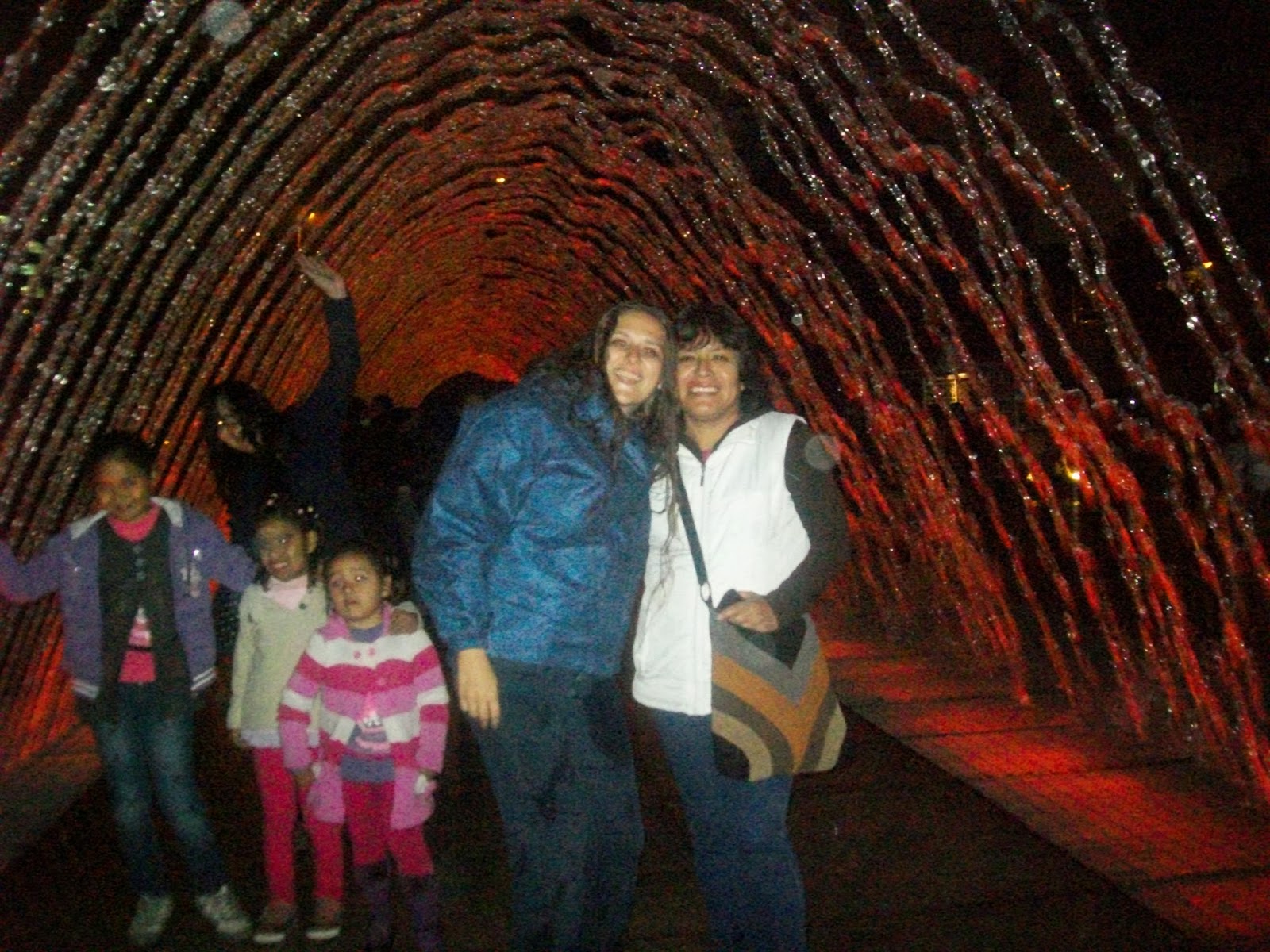
This weekend my family took me to Lima to a park with all these crazy fountains. Rebeca, Yeriln, Gianelia, and Rebeca´s mom all came. It was way more exciting than I expected it to be. Since a picture is worth a thousand words, here ya go:
Gianelia, me, and Yerlin
Me and my sisters

The water goes up and down, up and down, so you have
to time your entry and exit just right

We didn't time our exit just right


Host mom, Rebeca


This fountain had images of dancers projected in the water
Super cool!


Me and Gianelia's eyeball
Host Gma, Rebeca, me, and Gianelia


The park was in the center of Lima, so it was about a two-hour combi ride on a Saturday night. I think everyone fell asleep on the ride home except Rebeca, always the protective mother-hen. I really savored the moment since this was the second to last weekend that I would have with this host family.
Most of this week in training was spent preparing for our site visits next week. Everyone is going to go to their capital cities to meet (hopefully) some work colleagues and possibly a family member and then leave to our individual sites for three days. Everyone is excited and a little nervous at the same time. We have Heard numerous different stories from Volunteers about site visit. Some had horror stories, but the majority used the word “awkward” on more than one occasion.

We did get to visit the Lima office this week. There is a conference room, lots of offices, a library, and a small lounge for Volunteer use (but not overnight). The library has quite a bit of resources for our jobs and just other cultural or entertainment reading. The office is heavily guarded 24/7, a really safe space. Best part was that we were fed Pizza Hut pizza. It's different than American Pizza Hut, but that is a different blog topic all together. Still good though!


Site Visit

You are constantly hearing horror stories from experienced volunteers while you are in training…about training. The worst that I heard was about Field Based Training, but Site Visit stories ranked a close second. A lot of people told me about staying in their rooms for three straight days, watching 5 seasons of Grey's Anatomy or some other show. Others told me about mistakenly calling their male mayor a woman. Others told of being greeted by thousands of community members and having to improv “dar palabras” (“give words,” i.e. make a speech). No matter what the story (and there were a few good experiences I heard about), ALL included the word “awkward.” I was super lucky with my family in Tres de Octubre because I had Dylan, who speaks fluent Spanish. So, even though I had no idea what was going on during the first couple of weeks, I at least had a distraction – there weren't seven Peruvians just staring at me or desperately trying to communicate with me. I am not afforded this luxury this go round.

What is site visit? I left my comfort zone with my nice little family and my nice little training center to brave my new world for the next two years. We were all going to be gone from Chaclacayo for over a week. A day or so travelling, a day in our different capital cities to ask our new regional coordinators and fellow volunteers in our departments about stuff and possibly buy stuff for our rooms, a “socio day” where our new colleagues and possibly family members attend a whole day conference to discuss roles and expectations, three days at site, and another day in capital city to locate the things we will need to buy upon return, and another day travelling.

Bus ride as usual, hostel stay as usual, but my nerves are a little shot. I’m trying to think that staying in my room for three days might not be so bad. I’m super tired anyway. Hopefully this new family will understand. Socio day arrives. I plaster a fake smile on my face and do the disingenuous salutation exchange that people all around the world all do. From my teeny town, my new mom, the principal of the high school, the obstetrician from the med post, an auxiliary from the municipality (my municipality is located in a neighboring town, basically the county seat, but our little town has representatives), and my mayor (a huge honor here in Peru) all attended my socio day. I had more representatives than most. This was comforting. The principal was soooo excited that I was a psychologist. I was glad that he was glad, but I was also guarded because my job here is not therapy. I am definitely not qualified for that in this country. It is not that any type of authority here would care if I did therapy (except for maybe Peace Corps), but, ethically, I do not know enough about the culture to be guiding people through their problems and, personally, it would not be very good for my integration into the community when word got out that I am telling people to ignore their children’s temper tantrums. I can hear it now, “That crazy gringa told me to ignore my kids. It’s just like one of those devil-worshiping, egotistical Americans to say something like that (except all this would be in Spanish, of course).” Anyway, I can foresee this being a problem, but fingers crossed.

Ketty (obstetrician), Reina (host mom), me, Miryam (auxillary of the municipality), Segundo (principal)


I could see and feel in my heart the serious disappointment of all my new people that I don’t speak Spanish very well. There are three other trainees in my Lambayeque group that are fluent, so I’m sure in the eyes of my socios and mother, I looked like an idiot. My group of folks are really gung-ho. I can’t tell at this point if it is because they think that I don’t know what I’m doing, they have pity for me because of my language level or if they are just really this way. I figure that they are probably at least half as nervous as I am, so maybe the fact that they are doing EVERYTHING (all the activities in the conference) and I am doing NOTHING is a combination of all the newness and nervousness. Even for the volunteers who are fluent, the whole concept and follow-through of socio-day is completely rushed and so fabricated. I guess it is good for some to have a very structured atmosphere by which to meet and greet the people that you could potentially be working and living with intimately for the next two years, but, like the day that we discovered our site locations, I would have preferred at least an hour to chill and speak on a personal level, rather than jump into a bunch of structured activities (e.g., make a calendar of events for the volunteers’ first week, on a piece of butcher paper describe the roles of the host family, the volunteer, and the socio, etc.). Talk about impersonal!

I was so glad when it was all over, but still pretty shaken. I was leaving the comforts of having others surrounding me who understand my plight, my emotions, have complete and total empathy for my situation, and can speak English to embark on an adventure where I don’t know the people, the places, the customs, the ways of interaction, and above all, the language. My eight weeks of training suddenly seemed completely void of any utility. So me and my people exit the building. My regional coordinator has already explained to everyone that we will need to return to the hostel to collect my suitcases before we head for home. First of all, the hostel is about four blocks away from the location of socio day. I tell one socio, my obstetrician, who seems to be the one mostly in charge, “We can walk.” She tells me, “No, we can take a taxi.” I say, “But the hostel is less than four blocks away.” I’m feeling super superior at this point because that is the most Spanish that I have said to them all day, (Two sentences! WOW! I wasn’t kidding when I said that they were very gung-ho. Plus, they hadn't figured out yet that they need to slow their speech waaaaay down for the gringa to understand, so I had no idea what was going on in my group the majority of the conference.) and she understood me because she replied to me in a logical fashion. What’s more is that I, yours truly, understood her reply, although I didn’t like it. She says to me again, “We are going to take a taxi.” OOOOOK. Well then. So I made excuses in my head. She wearing heels. I wouldn’t wanna walk across the room in heels, let alone four blocks. By now, it is only me, my obstetrician, the representative lady of the muni, and my host mom. All four of us get into a teeny cab, and the obstetrician asks me for the name of the hostel. I tell her, “Hostel Santa Victoria.” The cabbie tells her something that I don’t understand, but I can read the body language enough to understand that he is communicating that he doesn’t know it. So, in Spanish, I say, “It is less than four blocks thatta way,” and I point. The cab driver shakes his head no. I insist. Yes, the name is Hostel Santa Victoria. Yes, it is less than four blocks in the direction that I indicated. Yes, it is close to the park with the Grecian monuments. I say all this yet again, and what does my obstetrician do? She tells the cab driver to pull over to where the other volunteers are standing on the sidewalk and ask one of the girls who speaks Spanish. UGH! Of all the low-down, dirty, stinking, rotten things! One of my biggest pet peeves is when people underestimate my intelligence! And the icing on the cake is that the volunteer chick that they asked has a reputation for her lack of intelligence! She couldn’t even tell them the name of the hostel! HA! She did, however, tell them that it’s about four blocks that way! OMG! While she’s struggling to remember the name, I whip out my receipt with the name, “HOSTAL SANTA VICTORIA” plain as day, in bold uppercase letters, across the top with the address and hand it to my obstetrician. I wish I would’ve known then how to say, “Told ya so! Told ya so!” She just laughed and commented on how fast I was to collect my receipt from my huge backpack.

So we ride in this cab for 30 seconds to the hostel, and when we get there, I’m feeling a little more confident and comfortable, and we have all had a good laugh about what just happened. So, I say, “We are going to have to get a different cab because I have a huge suitcase.” I can understand that I am new to this country and that my language sucks, but after the most recent episode, I mistakenly thought that I had somehow proved that I do have a little credibility, but no. They tell me, “Oh no, this cab is fine.” I disagree again, and mimic the dimensions of my suitcase with my hands, even exaggerating a little, to show them that there is no way on God’s green earth that my suitcase, my backpack, and five full-grown adults are going to fit in this cab. They just smile, laugh at my pantomime, and tell me again that we are going to use this cab. I know that my facial expressions ALWAYS tell my true emotions. This has been a problem since I was a kid. I had consciously been trying to fix my face basically all day, but this was the last straw. I threw my hands in the air, cussed in English, and turned around hastily to go get my suitcase. As soon as I exited the hostel (Hostel Santa Victoria, BTW), the cab driver says, “No, I can’t carry a suitcase that large.” I was beaming with pride for about 10 seconds until I realized that this is a horrible beginning to my integration with my new socios and host mom.

By the time that we get to Pampa La Victoria, which is actually the name of the town where I live, not La Cria, it is after dark. I’m tired, but I have all this nervous energy. I briefly meet my host brother, (Christian, 20 y/o), his wife (Miryam, 18 y/o), and my host sisters (Yesica, 19 y/o, and Dayhana, 5 y/o). They give me a quick tour of the house which took about 5 seconds, since there are two rooms. What do you think?


SIKE! These are pics of mock slaves’ quarters of the 19th century from the Afro-Peruvian museum from Field-Based Training. Bahahaha! I hope I got at least a couple of you out there. Teeheehee!

En serio (“seriously”), this is what I saw when I opened the door to my room. Way more terrifying than the slaves’ quarters, don’t ya think? In my mind, I could see the poster moving up close and far away over and over, and I could hear the soundtrack from the John Carpenter’s Halloween movies playing in my head. I let out an obscene chuckle, but quickly recovered and acted happy that I had a room with bright pink walls that included Hannah Montana staring down at me. (I sound incredibly ungrateful right now. I have so much more that a lot of other people. I have tiled floors, four full walls that reach the ceiling all the way, an electric light fixture, a door, a window, and an electrical socket. Minus the window and the door, all these other things are not a requirement of Peace Corps, and some volunteers do not have these things and a whole lot of Peruvians don’t have these things, so I am spoiled and lucky, but at the time, after socio day, it was such an alarmingly comical sight to be greeted to my new room by Hannah Montana, I couldn’t help but laugh). That night, we ate a small supper, watched a little TV, and I was in my room, watching a movie on my laptop by 8:00. It was so AWKWARD! Nobody spoke a word during supper. There were few words spoken after supper or any time that I was around. After I went in my room, they started talking almost immediately. I don’t blame them. I wanted to get away from them probably about the same amount as they wanted to get away from me.


Allow me to describe the house. When you walk in, there is the Internet “cabina” (“café,” but this is not a direct translation) with four computers, two Playstations, and a bunch of teenage boys. Then there is the living room and formal dining area. Following that is a long hallway. The master bedroom, where my parents and sisters sleep, is on the left. My brother and sister-in-law’s room and my rosy room are on the right. Past the hallway is the kitchen with a table where we usually eat and a little den with the television. Out back is a walled-in area (but no roof) where the family does the clothes-washing, stores the water barrels, and houses the chickens, rooster, and ducks. The shower and toilet are out there too. There are separate “rooms” for the toilet and the shower, but they both lead to this open-air area which is a little awkward. Everyone in the family just walks through to their bedrooms wrapped in a towel post-shower to get dressed, but I am going to search for a robe next time I go shopping. I'm posting this from my capital city and I forgot to bring my jump drive with some other pics on it, so I post more photos of the house in a future blog. 

Den

Den

Kitchen


The next morning, I heard typical morning rustling outside my room around 6:30. Although I could not go back to sleep, I didn’t want to start my day any sooner than I had to, so I laid in bed for nearly another hour until I had to use the bathroom so bad I couldn’t stand it any longer. I slept hardly any because the bed that I was furnished had a piece of ply board in the middle. (NOT kidding.) I ate a good breakfast with the family in near silence, except for the five-year-old chatterbox. Since I have no furniture, I had no place to put my things, so I couldn’t use the excuse of unpacking to stay in my room all day. I tried to help clean – my host mom was washing dishes, my sister and sister-in-law were sweeping and mopping the whole house – but to no avail. They are extremely hospitable. They always make sure that I have the best chair to sit in, which is the one chair that they have that has a back. All the chairs are plastic lawn chairs, but all but one are stools. My host mom, Reina, is giving me the best cuts of meat at mealtime. They won’t let me help clean. This is all super nice, but I feel like a guest in a hotel, not a family member. I hope that this changes with time, but on the second full day, my host mom told me that she didn’t have enough “confianza” in me to be allowed to help with the dishes. Confianza is similar to trust or confidence in another person. When two people have confianza, they have a very good interpersonal relationship that is built upon respect and reliance. It is a huge deal here in Peru. (Well, really anywhere, for that matter, but the word is spoken a lot more here than in the states.) So, I feel like I have a bigger challenge in the confianza area than some volunteers. We were told over and over again in training to NOT compare your situation with other volunteers, but Caroline tells me that her family sat her down on day one and told her that she is not a foreigner, that she is a family member and to call everyone by their family names, like “Mom,” and “Aunt,” etc. It is hard not to do a little downward social comparison when your self-esteem is as healthy as mine is, and then feel a little bit sad when my situation is on the lower end of the spectrum.

Well, all in all, I would rank my site visit as average. It was totally awkward, but that’s normal. I met a lot of people. The high school was on some holiday, but I met some parental units of the PTA, some teachers, some staff, and other authority-type folks in the community (e.g., the judge, a police officer). My socio, Miryam, and Reyna took me on a tour of the town(s). Previously I said I live in Pampa La Victoria, and you already know that I learned that my site assignment was La Cria. Well, there are two tee-nincey towns right next to each other. In America, they would be one town, but here, I guess if a canal with a ten-foot bridge exists, you separate the locations into two towns. This is true at Caroline’s site also. She lives in Mocupe, but works a lot in Ocupe. Weird. There are more thingys in La Cria, like a park, a concrete soccer/volleyball field, four schools, the Catholic Church, the market, but I think that the majority of the houses are in Pampa La Victoria. I live right behind the biggest building in town, the Mormon Church. Excuse me, La Iglesia de Jesucristo de Los Santos de Los Últimos Días. I thought Church of Jesus Christ of the Latter-Day Saints was a long name in English. My family is Mormon, and my mom told me how sometimes we have Mormon ceremonies in our living room, so I’m super stoked about that (not really, a bit of sarcasm.), and every person in town asked me if I was a Mormon when I met them. I did not meet any blonde, tall, white Mormon missionaries while I was at site, but I sure heard about them. Some folks said that my Spanish was better than some of theirs, so that’s cool. I made myself stay out of my room for a minimum of 13 hours a day. This way, I could say that I spent more than half of the day mingling with Peruvians. As soon as my 13-hour limit was up though, I raced to room. It is so tiring to translate every word that you hear and speak. Imagine concentrating on a math problem for 13 hours a day. That’s what it feels like. I didn’t get to meet my host father cuz he works out of town for a heavy machinery company, so he was in Cajamarca (where I visited for my Shadowing Trip). My sister and sister-in-law pretty much actively avoided me. When I would enter the room to watch television, they would leave and watch TV in the bedroom. The kids (my little sister and the billion kids in the neighborhood) loved me. My little sister and I played games on my tablet and took pics with my camera, and I played volleyball outside with the kids. The little ones are so much more receptive to me than adults.
My little sister, Dayhanna
OH! So, remember how I said that the Volunteer in Patapo, my district capital (i.e., county seat) was pretty rude to me during FBT? Well, I met him our first day during site visit, and he was super stoked to have me living so close. I still was pretty sure that we had nothing in common – he is a young, mega stud health nut from Colorado that speaks almost like he is an 18th-century romantic novelist or something (e.g., “There is nothing more pleasing in this earth than to help poor people,” “My destiny was to be at this site.”), I’m an old, down-to-earth Texas chica that like chicken-fried steak and not running – but it was decidedly refreshing that he was happy to have me. The first day of site visit, in Chiclayo (capital city), he says to me, “I feel like I should tell you something, but in private, much later. I don’t want everyone else to know just yet.” So, I just said, “OK, lemme know when you’re ready,” but in my head, I’m thinking, “Ugh. Drama queen.” Anywho, that afternoon, he pulls me to the side and tells me that he has had constant diarrhea for the 15 months that he has been in Peru. The docs have done a bunch of different tests and tried a bunch of different meds, but to no avail. Our doc in Peru was talking with the boss doc in D.C. to decide whether or not he should return to the states. About an hour after he told me, he got the call that he was going home. I felt so mean for thinking poorly of him, and I had serious sympathy for his problems, but that meant that I was going to get all his stuff. I am terrible. The guy gave me his mattress, plants, mirror, and three storage units for clothes and things. Super nice. I was relieved that all I had to buy now was a bedframe, decorations, and maybe a desk. There were all these mixed feelings about his leaving. I was sorta glad that I didn’t have to get to know one other person that I really couldn’t foresee us being great buds anyway (Like I’ve said before, I’m here to spend time with Peruvians, not Peace Corps peeps), but kinda sad that I was not going to have someone closer. On my way back to Chiclayo, my mom travelled with me to his site to make arrangements to get his stuff to my casa. It worked out really nicely.

So, that’s pretty much it for site visit. Mixed emotions, more stuff to think about, as has been the case since before I left. When I got back to Chaclacayo and Tres de Octubre, I was not really feeling rested since I slept on ply board for three nights, but I really wanted to cherish the last bit of time with this host family. My older sister, my host mom, and I went to the movies. It’s the same as in the U.S. It’s overpriced. The majority of the movies are American movies, in English with Spanish subtitles. We saw Scary Movie 5. Absolutely terrible, like the others, but I laughed a few times. The main differences are that in Peru, they have delivery service in the theater, so you don’t have to wait in line for your popcorn and drink. A waitress brings it to you before the movie starts. Much better, but the downside is that Peruvians pay absolutely no attention to the “please silence your cell phones” rule. All throughout the movie, people were not only texting, but talking on their phones as well. This is not just in the movies, but people do it in the middle of meetings and other seemingly important events too.

Soooooo, that's all, folks!